Blog
Outsourcing Giants vs. Big Tech: The Two Faces of H-1B Hiring
July 7, 2026
For 15 years the H-1B program's volume was built by IT-services staffing firms. The live FY2026 leaderboard has flipped toward product companies — and the two models hire, pay, and get approved in very different ways.
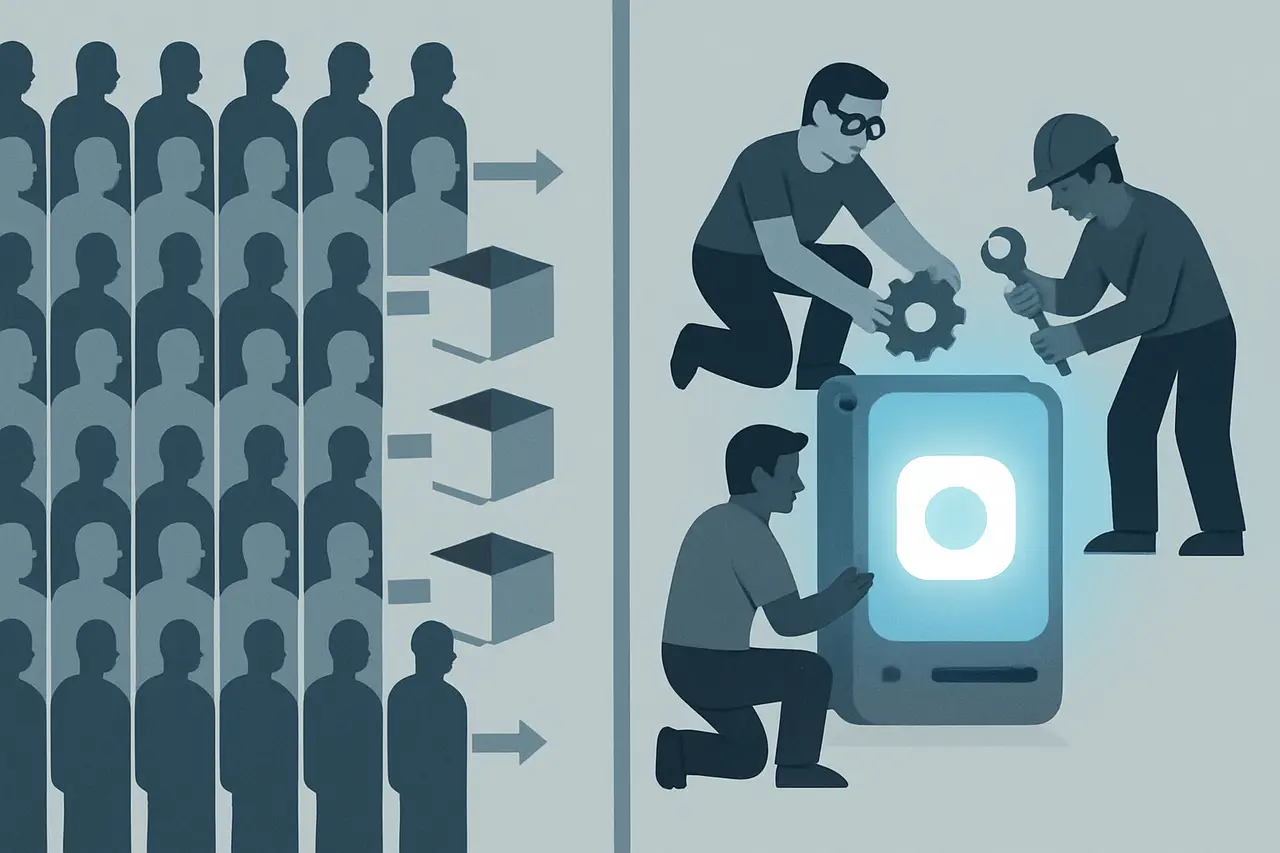
The H-1B program is often discussed as a single thing — a visa for "skilled foreign workers." But look at who actually files, for which jobs, at what wages, and the program splits cleanly in two. On one side are the IT-services and consulting firms that place staff on client projects. On the other are product companies building their own software. They use the same visa for opposite purposes.
This piece walks through that divide using disclosure data: who has filed the most over time, who leads right now, what jobs each side hires for, how often their applications get certified, and what they pay. The short version: the outsourcers built the program's volume, but the live leaderboard is tilting toward product engineering.
The all-time picture: staffing built the volume
Measured cumulatively, the labor condition application (LCA) filing counts are dominated by IT-services and consulting firms. Infosys leads by a wide margin at roughly 200,300 filings, followed by Tata Consultancy Services (~126,300) and Cognizant (~125,800). Deloitte Consulting (~79,200), Wipro (~71,000), and Capgemini (~59,900) round out the top tier.
That ordering reflects a business model, not just size. A staffing or "body shop" firm bills clients for placing consultants on projects, so its headcount — and therefore its visa filings — scales directly with contract volume. Over a 15-year window, those firms filed at a pace product companies never matched, which is why the historical leaderboard looks the way it does.
The live leaderboard has flipped
Now look at current filings for FY2026 and the picture changes. Product and platform companies lead: Amazon (~5,300 filings) sits at the top, with Ernst & Young, Apple, Google, Microsoft, and Meta all near the front. Cognizant and Infosys are still present, but they no longer own the top of the list the way their cumulative totals suggest.
This is the "then versus now" spine of the whole story. The stock of filings — everything ever submitted — is a monument to the staffing era. The flow — what's happening this year — increasingly belongs to companies hiring engineers for their own products. Reading only the all-time chart would leave you a couple of years behind where the program actually is.
Different jobs reveal different logic
The clearest evidence that these are two different programs is the job titles each side files for. Standard Occupational Classification (SOC) codes make the contrast concrete.
Infosys's most-filed roles are Computer Occupations, All Other (about 127,412 filings), Computer Systems Analysts (~24,773), and Software QA Analysts and Testers (~19,543). These are broad, interchangeable categories — deliberately so. A staffing firm needs job descriptions flexible enough to slot a worker into whatever a client contract requires next quarter. "Computer Occupations, All Other" is the catch-all that makes that flexibility possible.
Google's top role, by contrast, is Software Developers (~27,510 filings), followed by specialized functions like Data Scientists. These titles map to defined product-engineering jobs, not to whatever a client happens to need. Same visa, opposite hiring logic: one side staffs projects, the other builds a product.
The certification-rate gap tracks the same divide
Every LCA gets an outcome from the Department of Labor — most commonly certified, but sometimes withdrawn or denied. The certification rate turns out to track the two models closely.
Product-focused filers run clean and high. Amazon's development center posts a certification rate around 99.3%, Meta about 98.6%, and LTIMindtree roughly 99.0%. Large mixed and outsourcing filers convert lower — Cognizant sits near 53.6%.
It's important to read that gap correctly. A lower certification rate here is largely about precautionary and duplicate filings that end up certified-withdrawn, not about applications being denied for cause. High-volume staffing firms often file speculatively — covering multiple possible client placements or worksites — then withdraw the ones they don't use. That inflates the denominator and pulls the headline rate down without implying anything improper. A product company filing one application per real hire will naturally show a rate near 100%. If you're evaluating a sponsor, this is why our cleanest sponsors view separates true denials from routine withdrawals.
And so does the pay
Wages line up with the same split. The roles that dominate outsourcing filings sit toward the lower end of the tech wage band: computer systems analysts around $70,000 and computer programmers around $69,000. The roles that dominate product-company filings sit well above that — software developers around $102,000 and data scientists around $102,700.
The two models are effectively competing in different wage tiers. That matters if you're a worker comparing offers, or a researcher asking whether "the H-1B wage" is high or low — the answer depends entirely on which half of the program you're looking at. You can see the top of the wage distribution in the ranking below.
None of this means one tier is "real" H-1B and the other isn't. A $70,000 systems-analyst role and a $102,000 developer role are both legitimate filings. But averaging them into a single number hides the structure that actually drives the program.
Why the shift is happening
Several forces are pushing the live leaderboard toward product companies at once.
- Tighter lottery and adjudication. Changes to how the H-1B lottery is run and how USCIS scrutinizes petitions have reduced the payoff from filing enormous speculative volumes — the tactic that once let staffing firms dominate the counts.
- Softer offshore IT-staffing demand. The classic on-site consulting model has cooled relative to its peak, trimming the filing pace of the firms built around it.
- AI and cloud hiring. Product companies are hiring aggressively for machine learning, data, and cloud roles — specialized, higher-wage jobs that show up directly in their filings.
Put together, these trends mean the gap between the all-time chart and the live chart is likely to keep widening. The staffing era's totals aren't going anywhere — they're already banked. But the direction of new filings is increasingly a product-engineering story.
The takeaway
If you remember one thing: the H-1B program has two faces, and which one you see depends on whether you look at the stock or the flow. Cumulatively, IT-services and consulting firms built the volume through interchangeable, lower-wage staffing roles with high withdrawal-driven "noise" in their certification rates. Currently, product companies are pulling ahead with specialized, higher-wage engineering jobs and near-perfect certification rates.
For anyone using this data — a worker weighing an offer, a journalist tracking a sponsor, an employer benchmarking pay — the practical lesson is to always ask which model a given number describes. Start with the top sponsors and highest-paying jobs rankings, then drill into the specific employer or occupation you care about. The averages lie; the split tells the truth.
- H-1B
- outsourcing
- big tech
- LCA data
- wages
- sponsors